Emergency Garage Door Repair Near Me: What Eagan Homeowners Should Do First
When a garage door stops working, the first ten minutes decide how the rest of the day goes. Before you call anyone, you can sort out whether you’re dealing with a jammed track, a dead opener, or a broken spring, and that difference changes how urgent the situation really is. Most emergency calls get slowed down by a fuzzy description of the problem, not by technician availability. If you’d rather not troubleshoot on your own, call (844) 643-4886 and we’ll walk you through it.
Is it a jam, an opener failure, or a broken spring?
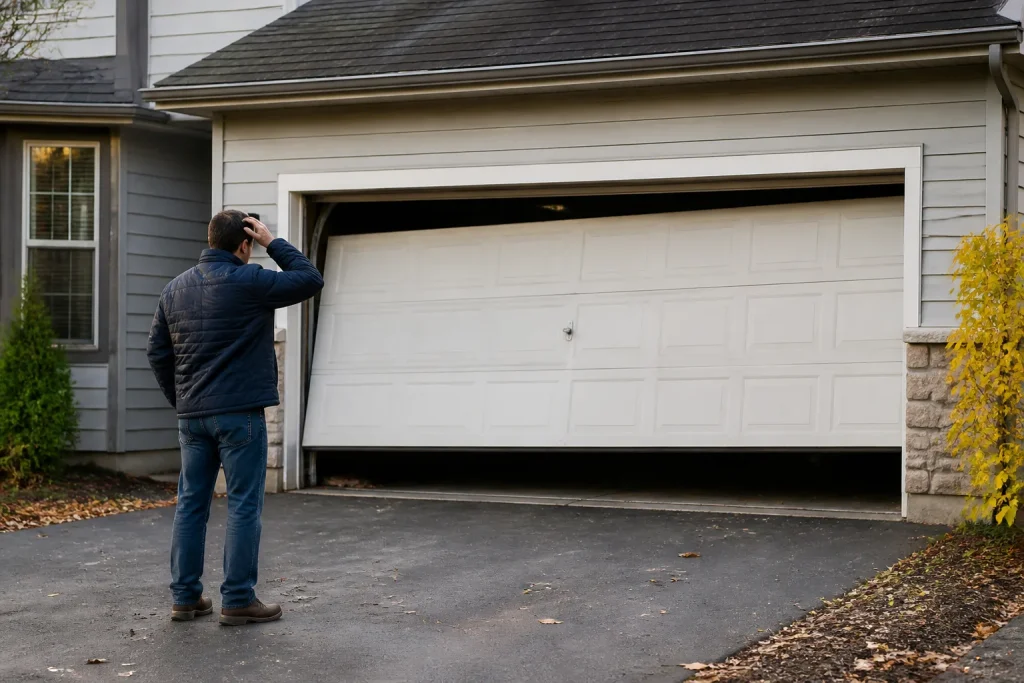
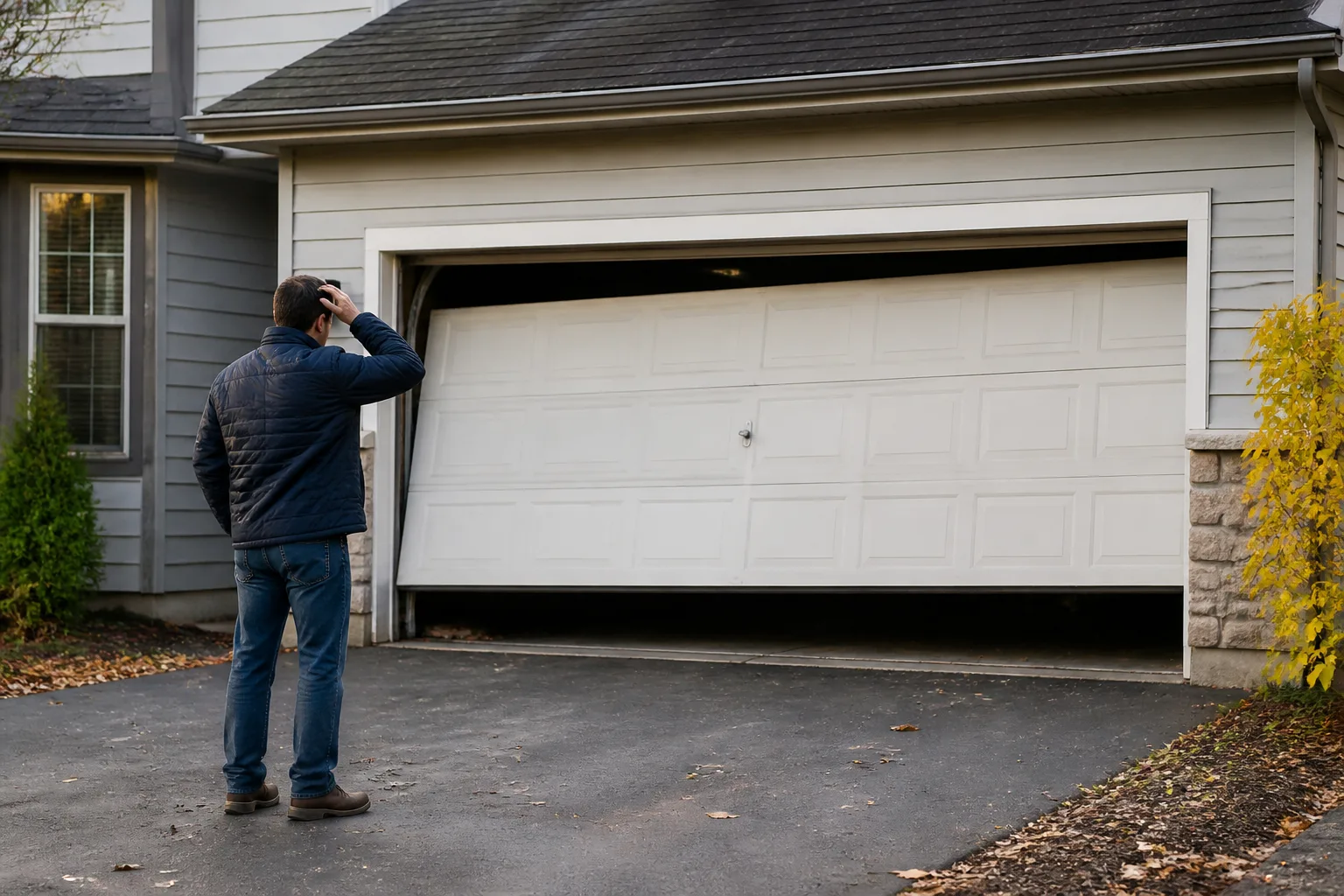
These are three different emergencies with three different urgency levels, and telling them apart before you call saves everyone a return trip. A jam usually leaves the door crooked or partway down. An opener failure leaves the door sitting straight but unresponsive. A broken spring leaves the door dead weight, and that one carries real danger.
Here’s how to sort them out from a safe distance:
- Look at the door’s position. Crooked, tilted, or stuck halfway with one side lower than the other points to a track or roller jam. Leave it where it is and keep clear.
- Listen to the opener. If you hear the motor run but the door doesn’t move, the opener or its drive is the likely culprit. If the motor hums and stops, that’s often a sign of strain against a mechanical problem rather than an opener failure alone.
- Check for a visible spring break. A torsion spring runs along the header above the door; an extension spring runs alongside the tracks. A gap in the coil, or a door that feels far heavier than it should when you lift it a few inches by hand, suggests a spring problem. Stop lifting at that point.
- Check the simple stuff last. Wall button, remote battery, and the safety sensors at the base of the tracks are worth a glance, since a misaligned sensor will stop a door that’s otherwise fine.
A jam and an opener fault are inconvenient. A broken spring is a safety issue. Treat them differently.
What should you never touch when a spring is involved?
Never try to remove, adjust, or wind a garage door spring yourself. The reason isn’t that springs are complicated to understand. It’s that a wound torsion spring holds hundreds of pounds of stored tension, and releasing that tension the wrong way can cause serious injury in an instant. This is the one part of garage door work where we tell every Eagan homeowner the same thing: stay back and call it in.
That caution extends to a few related habits:
- Don’t cut or unwind a broken spring to “release” it. It’s already released, and the remaining pieces are still under load in some configurations.
- Don’t try to force the door up with a pry bar or a car jack. A door with a broken spring can come down hard and fast.
- Don’t stand under a door that’s being held open by anything other than its own hardware.
Spring replacement done safely is a job for a trained technician with the right winding bars and the knowledge of how your specific door balances. We treat spring repair as a core service, not something to defer, because a door running on a compromised spring puts stress on the opener and the panels every time it moves. That’s part of why garage door spring repair is one of the calls we handle most often.
What information does a technician actually need over the phone?
The more precisely you describe your door and its failure, the more likely the technician arrives with the right hardware the first time. A second trip because the wrong spring or opener part came along wastes your afternoon and theirs. Here’s the short list to have ready:
- Door brand. If there’s a label on the inside of the door or along the bottom panel, read it off. Brands like Clopay, Amarr, and Wayne Dalton each use different panel and hardware designs, so the name narrows things down fast.
- Panel count and door type. A single-car door and a double-car door need different springs, and a sectional door is a different animal from a one-piece tilt door.
- Opener make and model. Look at the motor housing, usually on the ceiling. A Craftsman or LiftMaster label tells us which logic board and drive system we’re dealing with.
- Failure description. “Door goes up six inches then reverses” and “motor runs but door doesn’t move” point to very different diagnoses.
- What you’ve already tried. If you pulled the release cord or checked the sensors, say so. It saves a step.
Snap a photo of the door, the spring, and the opener label if you can. A picture over the phone is often worth more than a paragraph of description.
Why are fall and early spring the peak emergency seasons in Eagan?
Eagan’s temperature swings are hard on garage door hardware, and the shoulder seasons are when it shows. A stretch of mild afternoons followed by a hard freeze overnight works metal and lubricant in ways that a steady climate never does. Springs that were fine in October can sound different by November, and the same is true when winter lets go in March.
What happens is straightforward. Metal contracts in the cold and expands as it warms. Lubricant thickens when temperatures drop, so the opener works harder to move the same door. Rollers and hinges that were quiet in summer start to bind, and a door that’s slightly out of balance makes the spring and opener absorb that extra strain every single cycle. Do that a few hundred times over a Minnesota winter and small problems become emergency calls.
Homeowners in Eagan can get ahead of the peak by doing a simple check each fall and again as spring arrives: listen for new squeaks or grinding, watch whether the door travels evenly, and look at the springs for any visible gap. If the door feels heavier than it used to, that’s your cue to have it looked at before a cold snap finds the weak point for you. The same seasonal logic puts pressure on openers, which is why garage door opener repair calls pick up right alongside spring calls.
How do you get your car out while you wait for the technician?
In most cases you can safely disengage the opener by hand, and it won’t void your warranty or make the repair harder. The key word is manually: this is for a door whose springs are intact and whose tracks are clear. If a spring is broken or the door is jammed, don’t do this. The door won’t lift safely and it can come down hard.
When the door is otherwise sound, here’s the sequence:
- Close the door fully if it’s open and resting normally.
- Find the release cord, which hangs from the trolley on the opener rail. It usually has a red handle.
- Pull the cord straight down and toward the door to disengage the trolley from the carriage. You’ll hear or feel it release.
- Lift the door by hand slowly. A properly balanced door should feel manageable. If it feels like dead weight, stop and lower it carefully.
- Once your car is out, lower the door by hand and leave it closed.
Before the technician re-engages the opener, don’t run the motor with the door disengaged. Doing so can cause the trolley to travel past its limit and turn a simple fix into a bigger one. Leave the motor alone and let the technician reconnect it.
When should you call a pro instead of troubleshooting?
Call a professional the moment a spring is involved, the door is crooked or off its track, or the door drops faster than you expect when you test it by hand. Those are the situations where a trained technician prevents injury and saves you from making the repair more expensive. For a dead remote battery or a misaligned safety sensor, troubleshooting on your own is fine.
We’ve seen plenty of Eagan homeowners turn a straightforward opener reset into a bent track by forcing a door that was trying to tell them something. That’s the moment to put the tools down. Our technicians work on LiftMaster, Chamberlain, Genie, Clopay, Amarr, Wayne Dalton, Craftsman, and Raynor systems, so when you describe your door over the phone, the person on the other end already knows the equipment.
Related services in Eagan: for routine fixes, see garage door repair, and for a full look at what we handle, visit Eagan Garage Door Repair.
The Bottom Line
The ten minutes before you call matter. Identify whether you have a jam, an opener failure, or a broken spring, keep your hands off anything under spring tension, and gather the door brand, panel count, opener model, and a clear failure description before you dial. That’s what gets the right parts to your driveway on the first visit instead of the second. And it keeps you out from under a door that’s telling you it needs a professional.
If you’re in Eagan and need help, Eagan Garage Door Repair offers free estimates – call (844) 643-4886. We quote the price and agree on it before any work starts, so there’s no surprise when the job is done.
Frequently Asked Questions
Most emergency repairs in Eagan fall into typical ranges rather than a single flat fee, and the final price depends on what’s actually wrong. A spring replacement is priced per spring, and a matched pair is usually replaced together, so a pair runs about twice a single spring. Opener repairs and track or roller fixes are quoted separately. We give you a written estimate before any work begins, and that estimate sets the price.
In many urgent cases, yes. Emergency garage door service is a confirmed part of what we offer, and we treat a stuck or broken door as the security and safety issue it is. Call (844) 643-4886 and describe the failure; the more detail you give, the faster we can match a technician and the right parts to your door.
No. A door with a broken spring can fall suddenly and is dangerous to lift by hand. Keep everyone clear, don’t run the opener, and call for service. A trained technician handles spring replacement safely with the right tools.
Yes, every time. Telling us whether you have a Clopay, Amarr, Wayne Dalton, Craftsman, or another brand helps the technician arrive with the right hardware for your system. It’s the single easiest way to avoid a second visit.
Written by the team at Eagan Garage Door Repair.
Need Garage Door Help?
Call Eagan Garage Door Repair - the local pro we connect you with is licensed and insured, here with fast after-hours help in Eagan.
(844) 643-4886